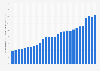
| Characteristic | Index (2015=100) |
|---|---|
| - | - |
| - | - |
| - | - |
| - | - |
| - | - |
| - | - |
| - | - |
| - | - |
| - | - |
| - | - |
| - | - |
| - | - |
| - | - |
| - | - |
| - | - |
| - | - |
| - | - |
| - | - |
| - | - |
| - | - |
| - | - |
| - | - |
The chart is not accessible to screen readers. Please switch to the table view to access the data.
December 2022
OECD
2001 to 2022
* PPP stands for Purchasing power parity.
The source did not provide an exact publication date.
The source adds the following information: "GDP per hour worked is a measure of labor productivity. It measures how efficiently labor input is combined with other factors of production and used in the production process. Labor input is defined as total hours worked of all persons engaged in production. Labor productivity only partially reflects the productivity of labor in terms of the personal capacities of workers or the intensity of their effort. The ratio between the output measure and the labor input depends to a large degree on the presence and/or use of other inputs (e.g. capital, intermediate inputs, technical, organizational and efficiency change, economies of scale). This indicator is measured in USD (constant prices 2015 and PPPs)."