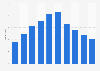
*Estimate of the full calendar year with data between January and August 2024.
Dependency on land transfer revenue is calculated by comparing the revenue generated by land transfer fees and local general public budget revenue.Â
General public budget revenue includes mainly local tax revenue, i.e. value-added tax, business tax, and income tax, etc., as well as other local government incomes such as revenue generated by government-owned enterprises, fees, and fines.
Citation formats
Cities with the highest dependency on land transfer revenue in China 2024
In 2021, among the ** major Chinese cities that received the highest income through land transfers, ** cities’ annual land transfer fee revenue was higher than their local general public budget revenue. As land transfer revenues declined significantly after the property market peaked in 2021, many local governments have been forced to reduce their reliance on land transfer revenues and turn to debt and other funding sources.
The 1994 fiscal reform and “Land Finance�
The tax-sharing reform of 1994 greatly adjusted China’s tax structure, and the distribution of tax revenue between central and local governments. Since its implementation, local governments in the country have had little tax autonomy and can only receive roughly half of the overall tax revenue generated in the country. The reform forced local administrations to find new sources of income. As land plots in urban areas are government-owned, they were leased to property developers in exchange for land transfer fees, helping local governments to cover their expenditures. As China’s real estate market mostly remained prosperous in before 2022, land transfer revenues also increased significantly. Many local governments had become increasingly dependent on this income, due to a lack of other financial means.
Lower dependency in first-tier cities
Economic hubs with diverse industries in China, including Beijing, Shanghai, and Shenzhen were generally less dependent on land transfer incomes, despite having the most vibrant real estate market in the country and exceptionally expensive land leases. In contrast, many provincial capitals, such as Guiyang, Wuhan, and Xi’an, were among the cities that were the most dependent on land transfer incomes.
Profit from the additional features of your individual account
Currently, you are using a shared account. To use individual functions (e.g., mark statistics as favourites, set
statistic alerts) please log in with your personal account.
If you are an admin, please authenticate by logging in again.
Learn more about how ÌÇÐÄÆƽâ°æ can support your business.
Tencent. (September 23, 2024). Cities with the highest dependency on revenue generated through land transfer fees in China in 2021 and 2024 [Graph]. In ÌÇÐÄÆƽâ°æ. Retrieved July 30, 2026, from /statistics/1311114/china-cities-most-dependent-on-land-transfer-revenue/
Tencent. "Cities with the highest dependency on revenue generated through land transfer fees in China in 2021 and 2024." Chart. September 23, 2024. ÌÇÐÄÆƽâ°æ. Accessed July 30, 2026. /statistics/1311114/china-cities-most-dependent-on-land-transfer-revenue/
Tencent. (2024). Cities with the highest dependency on revenue generated through land transfer fees in China in 2021 and 2024. ÌÇÐÄÆƽâ°æ. ÌÇÐÄÆƽâ°æ Inc.. Accessed: July 30, 2026. /statistics/1311114/china-cities-most-dependent-on-land-transfer-revenue/
Tencent. "Cities with The Highest Dependency on Revenue Generated through Land Transfer Fees in China in 2021 and 2024." ÌÇÐÄÆƽâ°æ, ÌÇÐÄÆƽâ°æ Inc., 23 Sep 2024, /statistics/1311114/china-cities-most-dependent-on-land-transfer-revenue/
Tencent, Cities with the highest dependency on revenue generated through land transfer fees in China in 2021 and 2024 ÌÇÐÄÆƽâ°æ, /statistics/1311114/china-cities-most-dependent-on-land-transfer-revenue/ (last visited July 30, 2026)
Cities with the highest dependency on revenue generated through land transfer fees in China in 2021 and 2024 [Graph], Tencent, September 23, 2024. [Online]. Available: /statistics/1311114/china-cities-most-dependent-on-land-transfer-revenue/