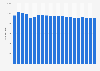
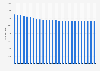
| Characteristic | 2017 | 2018 | 2019 | 2020 |
|---|---|---|---|---|
| - | - | - | - | - |
| - | - | - | - | - |
| - | - | - | - | - |
| - | - | - | - | - |
| - | - | - | - | - |
| - | - | - | - | - |
| - | - | - | - | - |
| - | - | - | - | - |
| - | - | - | - | - |
| - | - | - | - | - |
| - | - | - | - | - |
| - | - | - | - | - |
| - | - | - | - | - |
The chart is not accessible to screen readers. Please switch to the table view to access the data.
November 2020
Germany
2017 to 2020
14 years and older
German-speaking passenger car drivers
Computer-assisted personal interviews (CAPI)
Information on statistical population:
Base: German-speaking population aged 14 years and older.
Information on total sample:
2017: 23,106 respondents, projection to 70.09 million people
2018: 23,086 respondents, projection to 70.45 million people
2019: 23,120 respondents, projection to 70.60 million people
2020: 23,138 respondents, projection to 70.63 million people
Information on target group "German-speaking passenger car drivers":
2017: projection to 49.08 million people
2018: projection to 48.55 million people
2019: projection to 48.93 million people
2020: projection to 49.89 million people
The figures displayed refer to the following reports:
2017: VuMA 2018; 2018: VuMA 2019; 2019: VuMA 2020: 2020: VuMA 2021
Further information on the methodology is available and in the .
Figures were rounded for better understanding of the statistic.