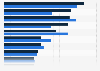


| Characteristic | Share of respondents |
|---|---|
| Attacks on IoT devices that may impact critical operations | 33% |
| Lack of skilled personnel to implement IoT security | 32% |
| Protecting sensitive data generated by an IoT device (encryption, tokenization, etc.) | 31% |
| Identifying or discovering sensitive data generated by an IoT device | 27% |
| Loss or theft of IoT devices | 27% |
| Lack of security frameworks and controls within the IoT environment | 26% |
| Privacy violations related to data generated by an IoT device | 26% |
| Lack of effective access controls/device authentication | 26% |
| Lack of industry standards for securing IoT devices | 25% |
| Validating the integrity of data collected by IoT devices (device identity, provisioning, PKI) | 7% |
| Privileged user access to IoT devices | 2% |
The chart is not accessible to screen readers. Please switch to the table view to access the data.
Loading statistic...
Download
Source
Sources
Release date
March 2020
More information
Region
Worldwide
Survey time period
November 2019
Number of respondents
1,723*
Special properties
executives
Method of interview
Online survey
Supplementary notes
*Respondents are executives with responsibility for or influence over IT and data security. Job titles ranged from C-level executives including CEO, CFO, CISO, chief data officer, chief data scientist, chief risk officer, SVP/VP, security analyst, IT administrator, security engineer, systems administrator.
Respondents mostly represented organizations ranging from 500 to 10,000 employees.
Organizations mostly represented industries in healthcare, financial services, technology, retail, and federal government.
Citation formats