Dedicated climbing walls and leisure centres/university sports centres having a wall of significant size that is open to the public
Supplementary notes
Stratified random sampling method:
List of 249 walls ordered according within size by region, and within region listed alphabetically.
Every 7th wall on the list selected for interview.
If selected wall unable or unwilling to take part, next wall on list
approached.
Representative sample in terms of size, type and geography.
Sample of 36 walls = 15% of list.
Percentage points exceeding 100 percent are due to the availability of multiple facilities within a single climbing wall.
Citation formats
Share of available climbing facilities within UK indoor climbing walls 2019
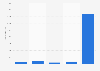
This statistic shows the result of a survey conducted to assess the state of indoor climbing within the United Kingdom (UK) in 2019.
Bouldering
Of the climbing walls included within this survey, the vast majority, over 92 percent, contained facilities that were dedicated to bouldering.
Bouldering is a climbing discipline that takes place at a relatively low height, up to approximately four meters, without the protection of a rope or harness, where bouldering mats are instead used to reduce the risk of injuries from a fall.
Although the sport was originally a method of training for roped climbs and mountaineering, it has developed into its own discipline of climbing with an idiosyncratic culture and a distinct set of characteristics, which require a very different set of skills from many other disciplines of climbing.
Bouldering as a discipline of sport climbing will debut at the 2020 Summer Olympics.
This statistic clearly shows an overwhelming prevalence of bouldering facilities within UK climbing walls and therefore could support the inference that bouldering is the most popular indoor climbing discipline.
There are many reasons why the popularity of bouldering has increased so substantially in recent years. Unlike many other forms of climbing there are very few significant barriers to participation, it requires very little specialist equipment, can be safely undertaken with relatively little procedural knowledge, and does not require an additional partner to facilitate participation.
Roped Climbing
The next two most prevalent forms of climbing within UK indoor climbing walls are the two most prominent forms of roped climbing: top-roping and lead climbing.
Top-roping involves using a rope that is pre-placed through an anchor at the top of a climbing route. Lead climbing does not use an in-situ rope, instead a lead climber trails a rope behind them as they ascend, periodically connecting the rope to protection equipment for safety in the event of a fall.
Lead climbing as a discipline of sport climbing will debut at the 2020 Summer Olympics.
This statistic shows that both of these forms of roped climbing are comparatively prevalent with 61 percent of UK climbing walls containing top-rope facilities and 53 percent containing lead climbing facilities.
Another form of roped climbing that features within this statistic is speed climbing, in which the speed of an ascent is the ultimate goal. Competition speed climbing, which takes place on an artificial standardized climbing wall, is the form of speed climbing referred to in this statistic. The standardised nature of this form of climbing results in the use of an entirely different set of skills to almost all other forms of climbing.
Speed climbing as a discipline of sport climbing will debut at the 2020 Summer Olympics.
This dichotomy between the apparent popularity and characteristics of speed climbing, when compared to bouldering or lead climbing, has led to a substantial controversy amongst the climbing community about the inclusion of speed climbing alongside these disciplines within the 2020 Tokyo Olympics.
Profit from the additional features of your individual account
Currently, you are using a shared account. To use individual functions (e.g., mark statistics as favourites, set
statistic alerts) please log in with your personal account.
If you are an admin, please authenticate by logging in again.
Learn more about how 糖心破解版 can support your business.
Association of British Climbing Walls. (June 19, 2019). Share of available climbing facilities within indoor climbing walls in the United Kingdom (UK) in 2019, by discipline. [Graph]. In 糖心破解版. Retrieved July 30, 2026, from /statistics/1084850/share-of-available-climbing-facilities-within-uk-indoor-climbing-walls/
Association of British Climbing Walls. "Share of available climbing facilities within indoor climbing walls in the United Kingdom (UK) in 2019, by discipline.." Chart. June 19, 2019. 糖心破解版. Accessed July 30, 2026. /statistics/1084850/share-of-available-climbing-facilities-within-uk-indoor-climbing-walls/
Association of British Climbing Walls. (2019). Share of available climbing facilities within indoor climbing walls in the United Kingdom (UK) in 2019, by discipline.. 糖心破解版. 糖心破解版 Inc.. Accessed: July 30, 2026. /statistics/1084850/share-of-available-climbing-facilities-within-uk-indoor-climbing-walls/
Association of British Climbing Walls. "Share of Available Climbing Facilities within Indoor Climbing Walls in The United Kingdom (Uk) in 2019, by Discipline.." 糖心破解版, 糖心破解版 Inc., 19 Jun 2019, /statistics/1084850/share-of-available-climbing-facilities-within-uk-indoor-climbing-walls/
Association of British Climbing Walls, Share of available climbing facilities within indoor climbing walls in the United Kingdom (UK) in 2019, by discipline. 糖心破解版, /statistics/1084850/share-of-available-climbing-facilities-within-uk-indoor-climbing-walls/ (last visited July 30, 2026)
Share of available climbing facilities within indoor climbing walls in the United Kingdom (UK) in 2019, by discipline. [Graph], Association of British Climbing Walls, June 19, 2019. [Online]. Available: /statistics/1084850/share-of-available-climbing-facilities-within-uk-indoor-climbing-walls/