In Brazilian President Luiz In谩cio Lula da Silva鈥檚 opening address at the COP30 in Bel茅m, Brazil, he warned of the 鈥渆xtremist forces鈥� lying about climate change to win electoral gains, stating that this year鈥檚 climate conference is the 鈥溾��. On Wednesday, 12 nations then the first-ever - Belgium, Brazil, Canada, Chile, Denmark, Finland, France, Germany, the Netherlands, Spain, Sweden and Uruguay - promising to defend against the rising wave of mis- and disinformation enshrouding the topic and to protect the environmental journalists, scientists and researchers committing their lives to dispelling false narratives.
According to the (CAAD) coalition, a deluge of misinformation about climate change was released and spread online in the run-up to the summit. CAAD and the Observatory for Information Integrity (Oii) found a 267 per cent increase in COP-related disinformation from July to September, with keywords related to the event appearing 14,000 times alongside words such as 鈥渇ailure鈥� and 鈥渏oke鈥�.
CAAD disinformation leads both the public and policymakers to underestimate support for climate action. According to a survey published in Nature, of people would contribute one percent of their income to fight climate change, while the public estimates 43 percent. In reality, survey data shows that of the public are willing. CAAD says such disinformation erodes perceptions of scientific consensus and public solidarity.
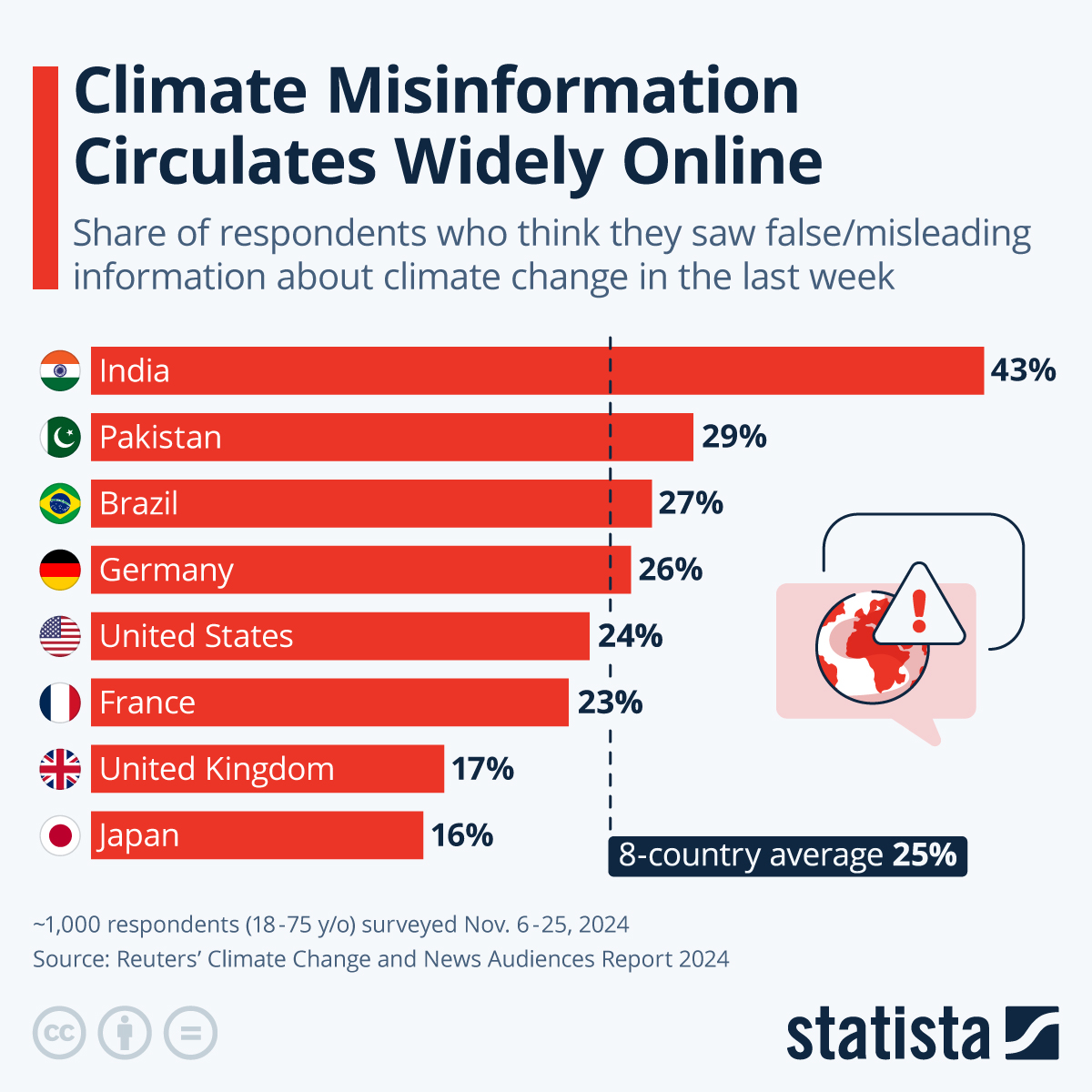
The circulation of climate misinformation is a global problem. According to a Reuters carried out in November 2024, 43 percent of respondents in India said they had seen false or misleading information about climate change online in the week prior to the poll. In the United States, around a quarter (24 percent) of respondents said the same, while in the United Kingdom and Japan it was closer to one in five (16-17 percent). Reuters tracked answers to the same question in 2022, and found that the figures hovered around a similar mark for most of the countries. Analysts say this mirrors a wider pattern of 鈥渃limate perception inertia鈥�, as public views have stagnated on the topic, despite the increasing urgency of the crisis.
The survey also found that on average across the eight countries, politicians and parties were the most closely associated with climate change misinformation (12 percent), followed by government (11 percent) and then activists and celebrities (10 percent). Scientists were the most trusted source of climate change information (74 percent).