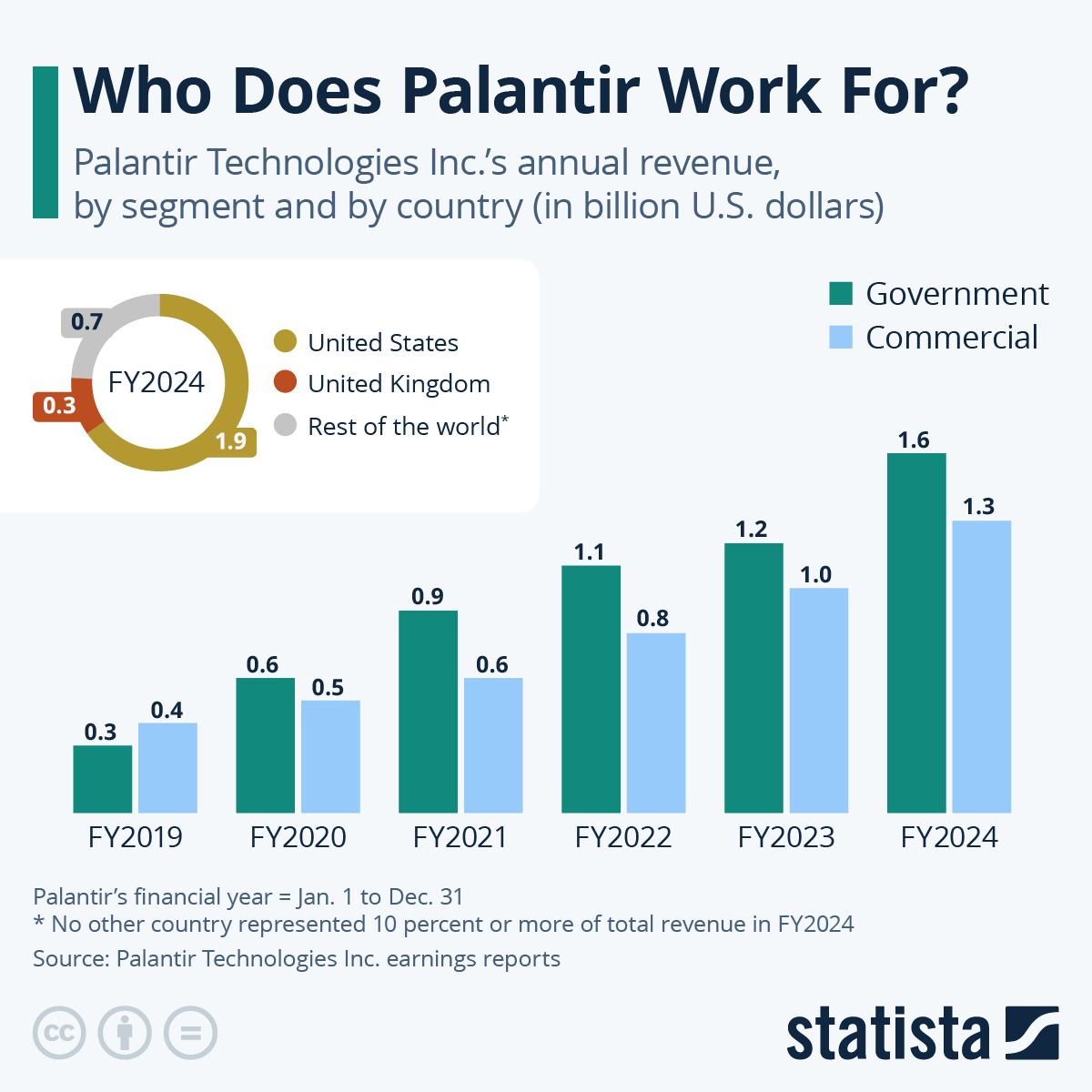
In 2024, the global revenue of Palantir, a data analytics company that works across a range of sectors including defense, hit $2.9 billion - around 55 percent of which came from government contracts. The company saw a 28 percent increase in revenue in such deals year-on-year from 2023 and a 29 percent increase in revenue from commercial contracts, according to Palantir鈥檚 financial.
Of its global revenue, 66 percent ($1.9 billion) came from the United States. This is up from the 62 percent share it accounted for in 2023, indicating that the U.S. is becoming an increasingly important player to Palantir. The United Kingdom is the next biggest purchaser of contracts, accounting for 11 percent of the global share in 2024, at just under $305 million. Palantir鈥檚 overall revenue increased around 29 percent year-on-year in 2024, earning an additional $640 million.
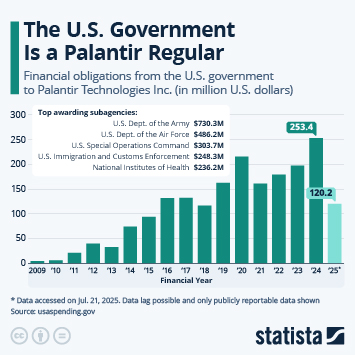
According to by The New York Times, Palantir has received more than $113 million in federal government spending since U.S. President Donald Trump took office, in addition to a that the Department of Defense awarded the company in May, which has not been paid yet.
Palantir鈥檚 technology has been used across multiple sectors, including healthcare by the and the UK鈥檚. It is perhaps better known for its use in the defense, military and secret services fields, however. The software has been used around the world, including by and by. Media reports also cite that its technology has been used 鈥溾�� by Kyiv in Ukraine.
In the United States, the Department of Defense鈥檚 work with Palantir can be traced back to the so-called 鈥淲ar on Terror鈥�, when Palantir鈥檚 software was used by U.S. military intelligence to predict locations of improvised explosive devices in Afghanistan. It is also used across other federal agencies, including Immigration and Customs Enforcement (ICE). In April, the U.S. awarded Palantir a to create an "" platform, intended to track undocumented people living in the U.S.
This article was updated on July 24, 2025, to clarify Palantir's relationship to the Israeli military. While Palantir states that it provides support to Israel鈥檚 military, it says it is not involved in the Lavender and Gospel programs used to pick targets in Gaza. The article also previously stated that Palantir is a surveillance company rather than a software company. While the company was not involved in surveillance itself, its software has been used as a tool by some customers for surveillance (for example, ).