With the global 10-percent tariff, announced by the just hours after the Supreme Court struck down the administration鈥檚 blanket tariffs in February, set to expire on Friday, the Trump administration is reportedly working on a way to impose a new set of tariffs that would replace the expiring ones. While the expiring tariffs were justified by "fundamental international payment problems", the new set of levies would be based on the , incl. the EU27, to fight imports of goods produced with forced labor. Whatever the reason, it is clear that President Trump is fighting to keep his tariff policy in place.
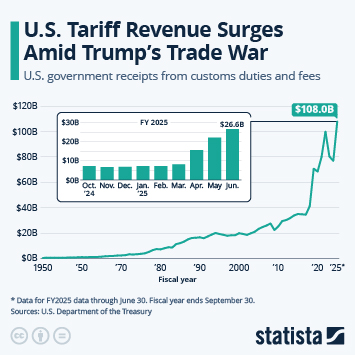
Despite a sharp rise in tariff revenues since Donald Trump鈥檚 return to the White House, customs duties still account for modest share of U.S. government income. In fiscal year 2025, tariff revenues surged to roughly $195 billion, equivalent to just 3.7 percent of total receipts. With more than $2.6 trillion, individual income tax continues to account for the largest share - just over 50 percent - of U.S. government receipts, with social insurance and retirement contributions accounting for one third of total receipts.
suggest that the importance of tariffs will increase in the coming years. That is, if the current high-tariff policy continues. Driven by sustained tariffs on imports, customs duties are projected to more than double in the coming years, exceeding $400 billion in fiscal year 2026 and reaching over $550 billion by 2031. Even then, tariffs would account for just 7.3 percent of total governement receipts, underlining their limited role in overall federal financing despite their growing importance in trade policy.