Nearly one in four U.S. adults would support a national divorce in the United States, where red and blue leaning states would divide into two countries, according to a recent carried out by The Economist and YouGov.
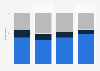
While a majority of U.S. adults disagree with the idea, a slight imbalance appears when looking at a breakdown along party lines. As our chart shows, a greater share of Republicans agreed with the statement 鈥淲e need a national divorce. We need to separate red states and blue states鈥︹�� than Democrats or Independents. Republicans were also nearly three times as likely to call secessionists 鈥渕ostly patriots鈥� (28 percent), versus Democrats (11 percent). Conversely, Democrats were more likely to call secessionists 鈥渕ostly traitors鈥� than Republicans would, at 49 percent and 26 percent, respectively.
Another question put to respondents, was their thoughts on allowing a single state to secede and to become a separate country so long as a majority of its inhabitants voted to do so, rather than having the entire nation split in two. It鈥檚 an issue that鈥檚 been raised before, with some if Hilary Clinton beat Trump in the 2016 election, while in 2017, driven by the left. The poll found that in this case, a slightly higher share of adults would be in favor (32 percent) and a slightly lower share opposed (43 percent) to the idea in comparison to the whole country being divided, while 25 percent remained undecided.
Debate around the 鈥榥ational divorce鈥� topic was reignited last month when Republican Representative Marjorie Taylor Greene called for it, or at least a form of federalism which would allow red and blue states to be governed separately. Her comments have drawn strong criticism on several grounds, including the fact that all states home voters from both sides of the aisle.
Michael J. Lee, author of We Are Not One People: Secession and Separatism in American Politics Since 1776, has since commented on the debate, arguing in an for Erie Times-News that while full secession may be at the extreme end of the scale and rhetoric, we are already seeing at least a 鈥渟oft separatism鈥� in the country.
More broadly, The Economist/ YouGov survey found that nearly two thirds of U.S. adults thought that the country today is headed off 鈥渙n the wrong track鈥� (36 percent Democrats, 80 percent Republicans, 67 percent Independents).