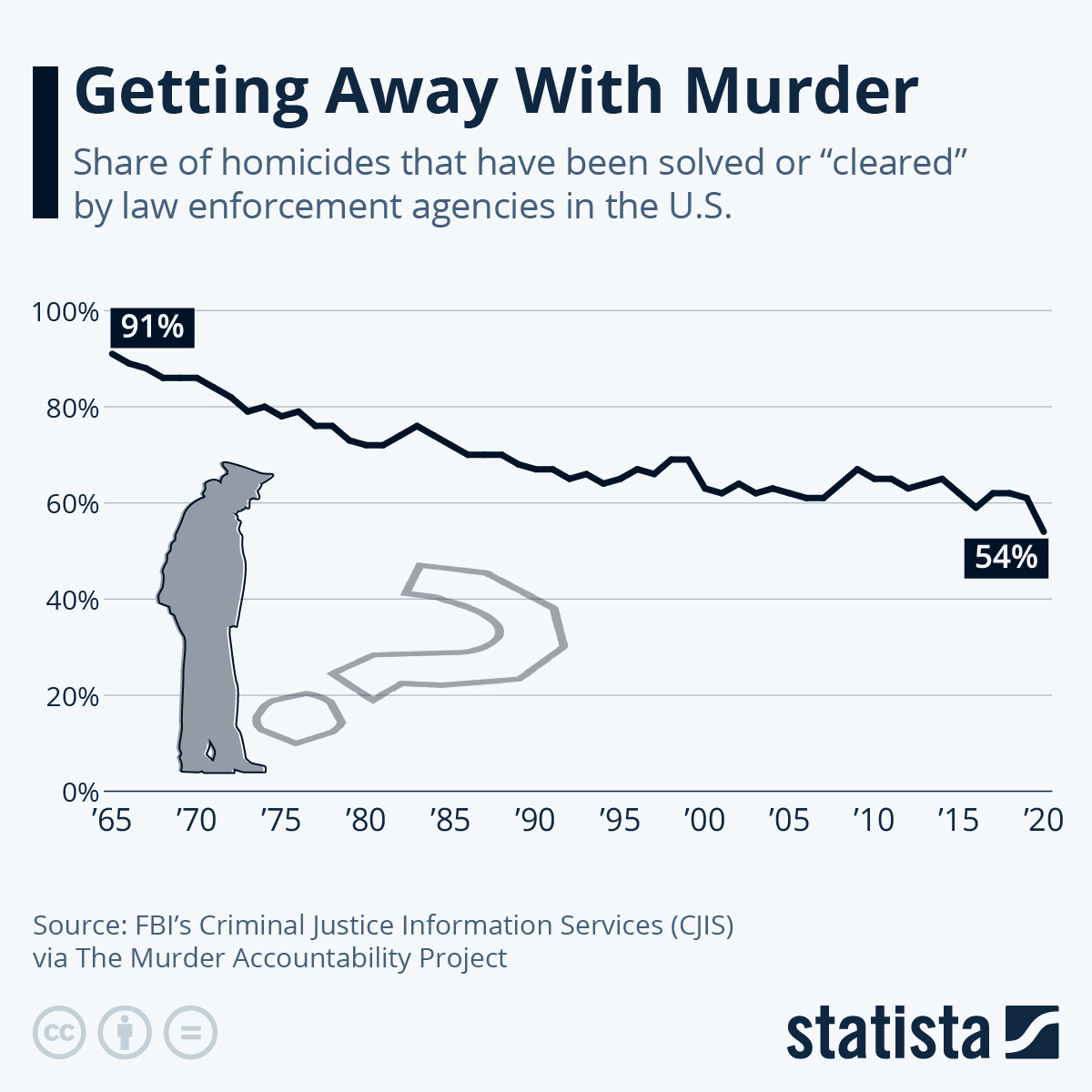
The share of murders going unsolved is on the rise in the United States, according to the FBI鈥檚 (CJIS). As our chart shows, 2020 saw a record low of only 54.4 percent of the country鈥檚 homicide cases cleared - or an estimated 9,836 out of 21,570 crimes. Due to data reporting delays, this is the latest available data.
A case is 鈥渃leared鈥� when either it is solved and the suspected killer has been arrested and formally charged or when the case has been deemed an 鈥渆xception鈥�, which means the assailant cannot be arrested, whether that鈥檚 because they are already dead, imprisoned elsewhere, or for another reason.
The sudden drop in 2020 can partly be attributed to the fact that homicides saw a nearly 30 percent increase that year, according to the FBI鈥檚 2020 Uniform Crime Report, which meant police and sheriff's departments were overwhelmed with cases.
The longer downward trend, however, is likely the result of a number of reasons. For instance, analysts argue that data collection in the 1960s and 1970s is not fully reliable and so their clearance levels are likely exaggerated. Meanwhile, more recently, a decline in police trust and willingness to work with law enforcement are also possible factors.
Jeff Asher, a crime analyst, explains in an interview with , that the rise in gun violence is a main contributor to the trend. Since guns can be shot from further away, gunshot homicides tend to be more difficult to solve. 鈥淭he nature of murder in America is changing in ways that we don鈥檛 really talk about enough鈥�, he explains. 鈥淵ou鈥檝e got a bunch of cities where firearms make up 80 to 90 percent of murders today. That is the main driver. Guns make murders much harder to solve, and it leads to lower clearance rates everywhere.鈥�