Almost three years after the for anticompetitive behavior in the search market, the most significant antitrust trial against a tech company since the United States against Microsoft in 1998 is set to begin on Tuesday. In October 2020, the DOJ had filed a lawsuit against Google for 鈥渦nlawfully maintaining a monopoly in general search services and search advertising in violation of the U.S. antitrust laws.鈥� The suit, which the DOJ describes as 鈥渁 monumental case for the Department of Justice and, more importantly, for the American consumer鈥� in its , accuses Google of being 鈥渁 monopoly gatekeeper for the internet鈥� engaging in 鈥渁nticompetitive tactics to maintain and extend its monopolies鈥�.
At the center of the case is Google鈥檚 well-known practice of paying large amounts of money to device manufacturers, wireless carriers and browser developers to make sure Google is the default search engine on devices and within browsers. According to the DOJ鈥檚 findings, such agreements cover almost 60 percent of all search queries in the United States, with a large part of the remaining share funneled through Google鈥檚 own properties (e.g. its Chrome browser and Google devices). As a result, Google has become 鈥渟o dominant that 鈥淕oogle鈥� is not only a noun to identify a company and the Google search engine but also a verb that means to search the internet,鈥� the DOJ writes in its complaint.
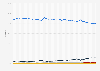
As the following chart shows, Google鈥檚 dominance over the U.S. search market can in fact be described as monopolistic. According to , a company tracking more than 5 billion pageviews across more than 1.5 million websites per month, Google鈥檚 market share in the U.S. currently amounts to 79 percent on desktop devices and more than 95 percent on mobile devices (excluding tablets). A dominant market position alone is not against the law, however, as the case's judge Amit P. Mehta pointed out in a statement last month. "A dominant firm like Google does not violate the law merely because it occupies a monopoly market position," Judge Mehta wrote. " It must act in a manner that produces anticompetitive effects in the defined markets. That is, a company with monopoly power acts unlawfully only when its conduct stifles competition."
This is precisely Google's argument, which maintains the position that its dominant market position is a result of the quality of its services and consumer preferences rather than of anticompetitive behavior. In a published last week, the company dismisses the lawsuit as 鈥渄eeply flawed鈥�, stating that 鈥減eople don't use Google because they have to - they use it because they want to." "Success doesn鈥檛 come from preloading," Google says with respect to the allegations at the heart of the case, "it comes from innovation and offering helpful products that people want to use."