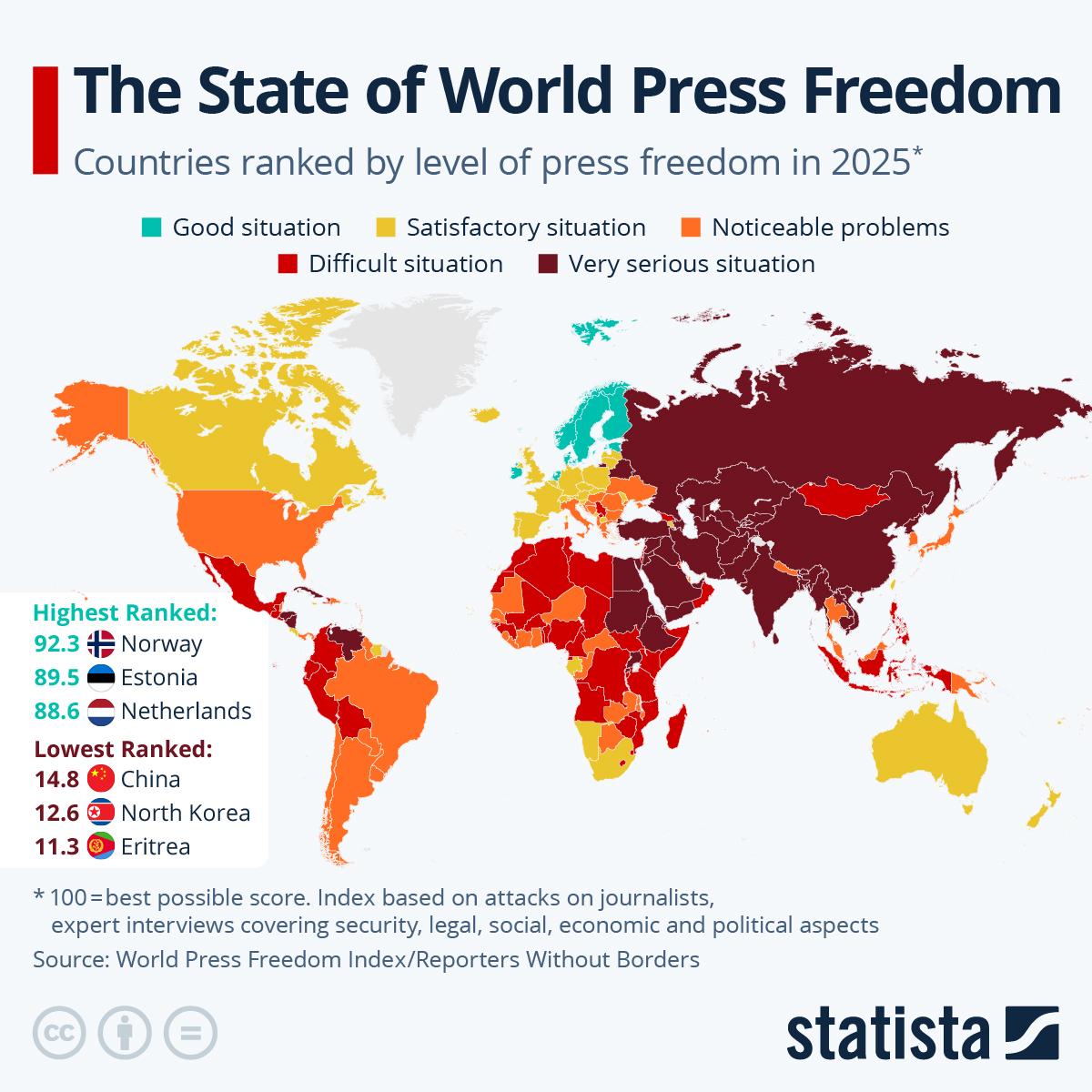
Reporters Without Borders (RSF) just released the 2026 version of its . This year, the release highlights that press freedom in the world is at a 25-year low, with over half of the world鈥檚 countries now falling into the 鈥渄ifficult鈥� or 鈥渧ery serious鈥� categories for the first time in the history of the index. Only 13.7% of countries fell under these categories in 2002. The organization also notes that press freedom has declined in 100 out of 180 countries this year.
RSF writes that since 2001, "the expansion of increasingly restrictive legal arsenals 鈥� particularly those linked to national security policies 鈥� has been steadily eroding the right to information, even in democratic countries". The United States, for instance, has dropped seven places in the ranking compared to 2025. Out of the five indicators used to assess press freedom worldwide 鈥� which determine the economic, legal, security, political and social environments for journalism 鈥� the legal indicator has seen the sharpest decline this year,"a clear sign that journalism is increasingly criminalised worldwide" according to RSF.
Taking a look at wider trends, this chart shows that 42 countries were listed in the worst category in the index 鈥� where there exists a 鈥渧ery serious鈥� situation of the press. Norway is once more at the top of the list, ranking in first place for the tenth year running, followed by the Netherlands and Estonia. The final trio, considered the most repressive countries for the press, are China (in 178th position), North Korea (179th) and Eritrea (180th). Reporters Without Borders notes that in 2002, 20% of the global population lived in a country where the state of press freedom was categorized as 鈥済ood鈥�. In 2026, less than 1% of the world鈥檚 population lives in a country that falls under this category.