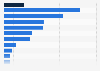
| Characteristic | Number of injuries to workers |
|---|---|
| - | - |
| - | - |
| - | - |
| - | - |
| - | - |
| - | - |
| - | - |
| - | - |
The chart is not accessible to screen readers. Please switch to the table view to access the data.
November 2017
United Kingdom (Great Britain)
April 1, 2009 to March 31, 2017
* Employer-reported non-fatal injuries to employees. Self-employed workers are included. Figures for 2016/2017 are provisional.
The source defines 'major injuries' as any of the following:
- fractures, other than to fingers, thumbs and toes
- amputations
- any injury likely to lead to permanent loss of sight or reduction in sight
- any crush injury to the head or torso causing damage to the brain or internal organs
- serious burns (including scalding) which:
covers more than 10% of the body
causes significant damage to the eyes, respiratory system or other vital organs
- any scalping requiring hospital treatment
- any loss of consciousness caused by head injury or asphyxia
- any other injury arising from working in an enclosed space which:
leads to hypothermia or heat-induced illness
- requires resuscitation or admittance to hospital for more than 24 hours